Choosing the right men’s haircut becomes much easier when you can imagine how the style looks from every angle. Fade and Taper Haircuts Front and Back Views reveal details that a simple front-facing photo often misses, including how high the fade begins, how smoothly the sides transition, how the neckline is finished, and how the haircut connects to the longer hair on top. Two cuts can look surprisingly similar from the front while creating completely different silhouettes from the side and back.
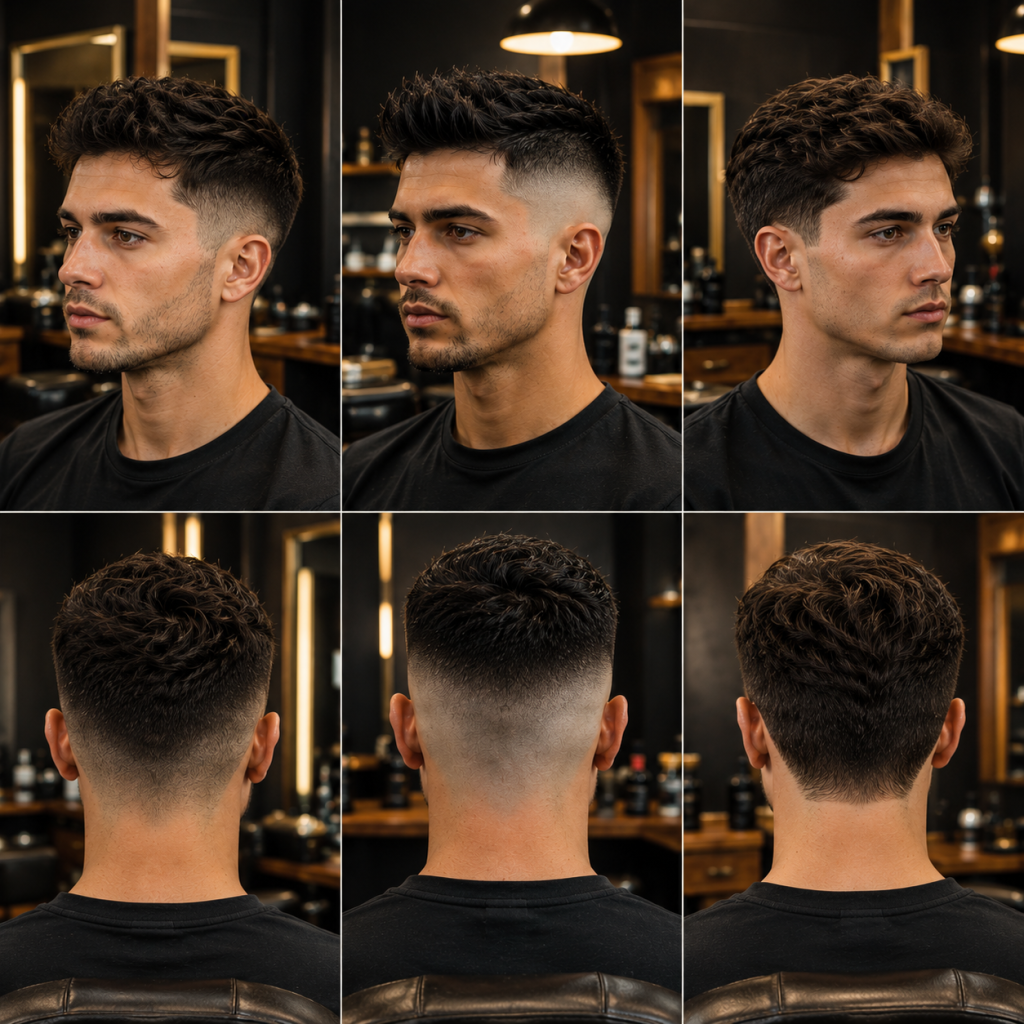
Among the many variations available today, three styles stand out for their versatility and visual impact: the Low Fade, High Fade, and Taper Fade. Each offers a different balance between contrast, neatness, maintenance, and personality. ✂️
The low fade creates a subtle transition close to the ears and neckline. The high fade produces significantly stronger contrast by removing more hair from the sides and back. The taper fade takes a more restrained approach, concentrating much of the shortening around the sideburns, ears, and neckline while preserving greater fullness elsewhere.
Understanding these differences from both the front and back can make the difference between choosing a haircut that simply looks good in a reference photo and choosing one that genuinely complements your hair, face, and preferred style.
Why Fade and Taper Haircuts Front and Back Views Matter ✂️
A haircut is three-dimensional. Although the front is naturally where most people focus their attention, the back determines a surprisingly large part of the haircut’s overall quality.
From the front, attention usually goes toward the hairline, fringe, temples, top length, and relationship between the longer top and shorter sides. A fade may appear dramatic or subtle depending on how much skin is visible around the temples.
Turn the same haircut around, however, and an entirely different set of details becomes important.
The back reveals the fade gradient, occipital area, neckline, crown transition, and overall head shape. This is often where excellent barbering becomes particularly noticeable. A beautifully executed fade should move gradually from very short hair into longer sections without obvious lines or patches.
Front and back views are therefore especially useful when comparing different fade heights. A low fade may seem only slightly different from a high fade when viewed directly from the front, but the distinction becomes unmistakable from behind.
The same principle applies when comparing a conventional fade with a taper. A taper leaves considerably more natural weight through the sides and back, creating a fuller silhouette.
That makes viewing both angles valuable before deciding which haircut to request.
Quick Comparison of the Top 3 Fade and Taper Haircuts
| Haircut | Front View | Back View | Contrast | Maintenance | Best For |
|---|---|---|---|---|---|
| 🥇 Low Fade | Clean and subtle around temples | Gradual transition near neckline | Medium | Moderate | Versatile everyday styling |
| 🥈 High Fade | Bold exposed sides with strong top contrast | Dramatic short-to-long transition | High | Higher | Modern statement hairstyles |
| 🥉 Taper Fade | Natural and polished | Fuller back with clean neckline | Low to Medium | Lower | Classic professional looks |
While these categories provide a useful starting point, the final result also depends on top length, hair texture, fade starting point, clipper length, neckline shape, and styling technique.
A curly high fade, for example, creates a completely different visual impression from a high fade combined with a short buzz cut. Likewise, a taper paired with medium-length textured hair can appear relaxed and contemporary, while the same taper underneath a side part can look polished and traditional.
Important Note: A reference photo should ideally show the front, side, and back of the haircut. Fade height and neckline details can dramatically change the finished result, so showing multiple angles gives a barber much clearer information than simply asking for a “fade.”
🥇 Best 1 Low Fade for a Clean Balanced and Versatile Look
The low fade earns the first position because it offers perhaps the strongest balance between modern styling and everyday versatility.
Instead of beginning high on the head, the transition starts relatively close to the ears and lower hairline. The result preserves more hair through the upper sides while still delivering the clean gradient associated with contemporary fade haircuts.
This characteristic makes the low fade extremely adaptable.
It can accompany short textured crops, curly tops, pompadours, quiffs, side parts, slicked-back hairstyles, crew cuts, and many other looks without overpowering the hairstyle itself.
The fade becomes a supporting element rather than the entire visual statement.
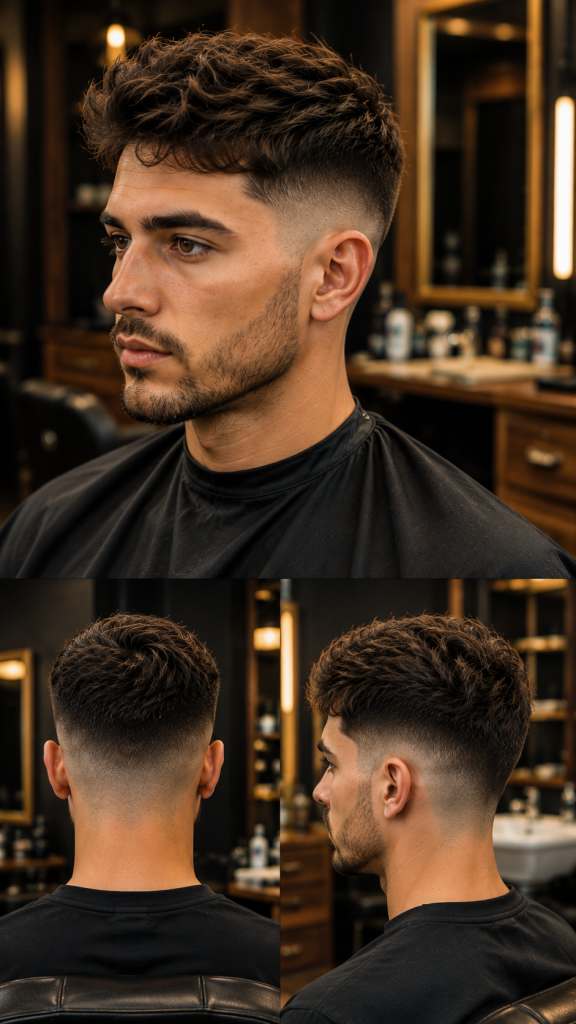
Low Fade Front View
From the front, a low fade generally creates a clean outline around the temples without exposing as much scalp as a high fade.
Because more hair remains along the sides, the head retains a relatively natural silhouette. This can be particularly useful when the goal is to create a modern haircut without making the transition look excessively dramatic.
The top remains the dominant feature.
With a textured crop, the eye is naturally drawn toward the fringe and texture. With a quiff, attention moves upward toward the volume. With curls, the contrast highlights the natural texture while the lower sides remain tidy.
This is one reason the low fade works across so many styling preferences.
It creates definition without demanding attention.
The front view can also appear especially balanced when the fade is blended carefully into the temple area. Instead of creating an abrupt separation between the top and sides, the haircut maintains enough visual weight to produce a smooth, cohesive silhouette.
How the Low Fade Frames the Face
The low fade subtly cleans the area around the ears and temples, which can help sharpen the overall appearance of the haircut.
Because it does not remove as much hair from the upper sides as a high fade, it usually creates less extreme vertical emphasis.
That makes it useful for men who want to preserve some width around the head.
The exact effect depends heavily on the hairstyle above it. Longer volume on top can make the haircut appear taller, while a short textured top keeps the overall proportions more compact.
A barber can also adjust the low fade to make it softer or sharper.
A low skin fade creates greater contrast by fading down to bare skin. A low shadow fade keeps slightly more visible hair at the shortest point, resulting in a softer finish.
Both belong to the same general family but create noticeably different impressions.
Low Fade Back View
The back is where the structure of a low fade becomes particularly easy to recognize.
The shortest section normally sits relatively close to the neckline before gradually transitioning into longer hair as it moves upward.
Rather than exposing a large portion of the back of the head, the fade occupies a relatively compact lower area.
This creates a natural progression from the neck toward the crown.
When executed well, there should be no obvious horizontal line separating the different clipper lengths. Instead, each section melts into the next.
The low position also allows the natural shape of the head to remain visible without exaggerating it.
From behind, this can produce a sophisticated and understated result.
Low Fade Neckline Options
The neckline can influence the finished appearance almost as much as the fade itself.
A barber may use a natural, rounded, or more squared finish depending on the haircut and individual preference. When the low fade reaches very short lengths around the neck, the transition itself may effectively replace a conventional neckline.
This creates an exceptionally clean lower edge.
As the hair grows, however, the shortest area becomes visible relatively quickly. Regular maintenance is therefore useful if maintaining that freshly faded appearance is important.
For many people, a touch-up every few weeks keeps the haircut looking polished without requiring extremely frequent barber visits.
Who Should Choose a Low Fade
A low fade is an excellent choice for someone who wants versatility.
It works particularly well when a dramatic high fade feels too aggressive but a traditional taper seems too conservative.
The style occupies a comfortable middle ground.
It can transition easily between casual and professional environments, depending on the top hairstyle. Pair it with a neat side part and the result can look sophisticated. Add messy texture and it becomes younger and more relaxed. Combine it with curls and the clean lower sides allow the natural texture to become the main feature. 💈
This adaptability is exactly why the low fade deserves the top position among the three choices.
🥈 Best 2 High Fade for Maximum Contrast and a Bold Modern Finish
For those who want the haircut itself to make a stronger visual statement, the high fade is difficult to beat.
The defining difference is immediately visible: the fade begins much farther up the sides and back of the head.
Because the transition occurs higher, a larger area is cut extremely short.
This creates dramatic separation between the hair on top and the sides.
The result feels sharper, bolder, and often more athletic than a low fade or taper.
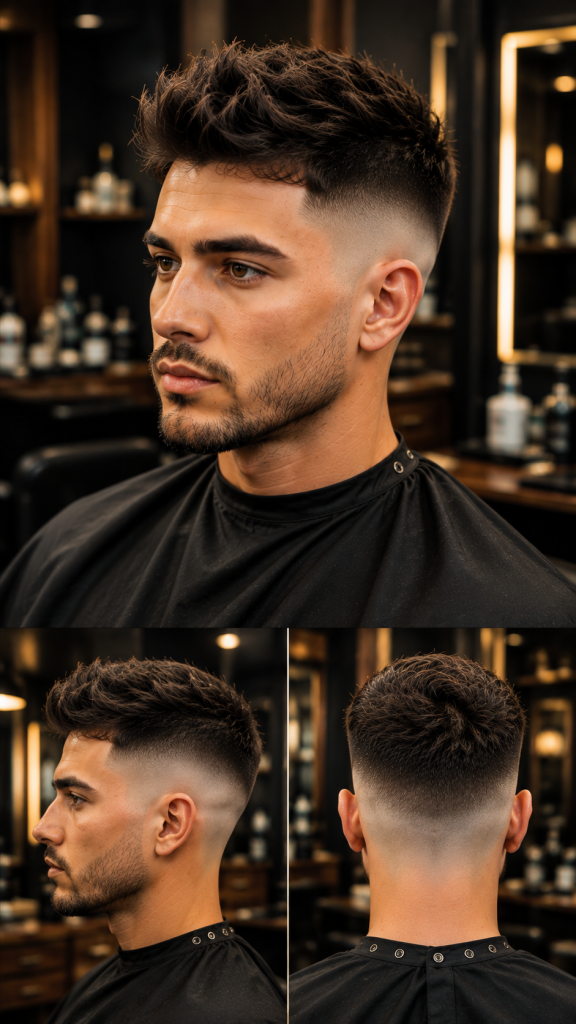
High Fade Front View
From the front, a high fade makes the upper hairstyle extremely prominent.
The sides appear narrow and clean because much of their visual weight has been removed. This naturally directs attention upward.
A textured top becomes more noticeable.
A pompadour looks more dramatic.
Curls appear more concentrated.
Even a relatively simple short haircut can acquire a strong contemporary character when paired with a high fade.
This strong contrast is one of the main reasons the high fade remains popular in modern barbering.
Why the High Fade Changes the Silhouette
Removing substantial volume from the sides changes the perceived proportions of the head.
The hairstyle can appear taller and more vertically oriented, particularly when there is significant volume on top.
That effect can be desirable when creating a sharp, structured aesthetic.
However, it also means that the high fade is less visually subtle than the low fade.
Someone who wants to retain fuller sides may find it too aggressive.
The difference is particularly obvious when comparing Fade and Taper Haircuts Front and Back Views side by side. The taper preserves much of the natural silhouette, while the high fade intentionally removes it.
This is not simply a difference in clipper length.
It changes the architecture of the entire hairstyle.
High Fade Back View
Turn a high fade around and its defining characteristic becomes even clearer.
The shortest area extends much farther upward across the back of the head. Depending on the exact variation, the transition may begin near or above the temple level before blending into the longer crown.
This creates a broad clean section through the lower and middle back.
The gradient therefore becomes a major visual component of the haircut.
With a skin fade, the lower section can be completely bare before gradually darkening upward.
The effect is bold and highly polished when freshly cut.
Because the fade occupies more surface area, inconsistencies in blending can also become easier to notice. A high fade requires careful transitions so that the haircut does not develop visible bands.
Smooth barbering is particularly important here.
The Crown Connection
The connection between the high fade and crown deserves special attention.
If the fade is taken too high without considering the natural growth pattern, the crown can appear disconnected from the rest of the haircut.
An experienced barber normally evaluates density, growth direction, head shape, and the desired top length before deciding exactly where the blend should finish.
This is why simply requesting a “high fade” does not completely describe the desired haircut.
Photos showing the back can communicate how much weight should remain underneath the crown.
For textured or curly hair, preserving the correct amount of weight can make the difference between a balanced shape and an overly narrow result.
High Fade Maintenance
The cleaner and shorter a fade becomes, the more obvious its growth tends to be.
A high skin fade is especially noticeable as new hair begins appearing across the previously bare lower section.
This does not mean the haircut immediately looks bad.
In fact, a well-executed fade should grow out relatively evenly.
However, anyone who wants to maintain the extremely crisp contrast of a fresh high fade will generally need more frequent barber visits than someone wearing a softer taper.
This is an important practical consideration.
The boldest haircut often requires the strongest maintenance commitment.
Who Should Choose a High Fade
Choose the high fade when strong contrast is part of the goal.
It is ideal for showcasing a distinctive top hairstyle and works particularly well with short textured cuts, curls, crop styles, crew cuts, pompadours, and many modern barber-inspired looks.
It can also work extremely well with very short hair.
A high fade combined with a buzzed or cropped top creates a clean, minimalist appearance in which shape and precision become the primary design elements.
The key question is whether you want the sides to disappear into the background.
If the answer is yes, the high fade is likely the strongest option of these three. 🔥
🥉 Best 3 Taper Fade for Natural Fullness and Timeless Style
The taper fade takes a different approach.
Rather than dramatically fading a large portion of the sides and back, the haircut generally concentrates the transition around specific edges, particularly the sideburns and neckline.
More hair remains throughout the rest of the head.
This creates a softer and more natural silhouette.
It is an excellent option for anyone who appreciates the cleanliness of faded edges but does not want the dramatically exposed sides associated with a high skin fade.
The result sits comfortably between traditional barbering and modern styling.
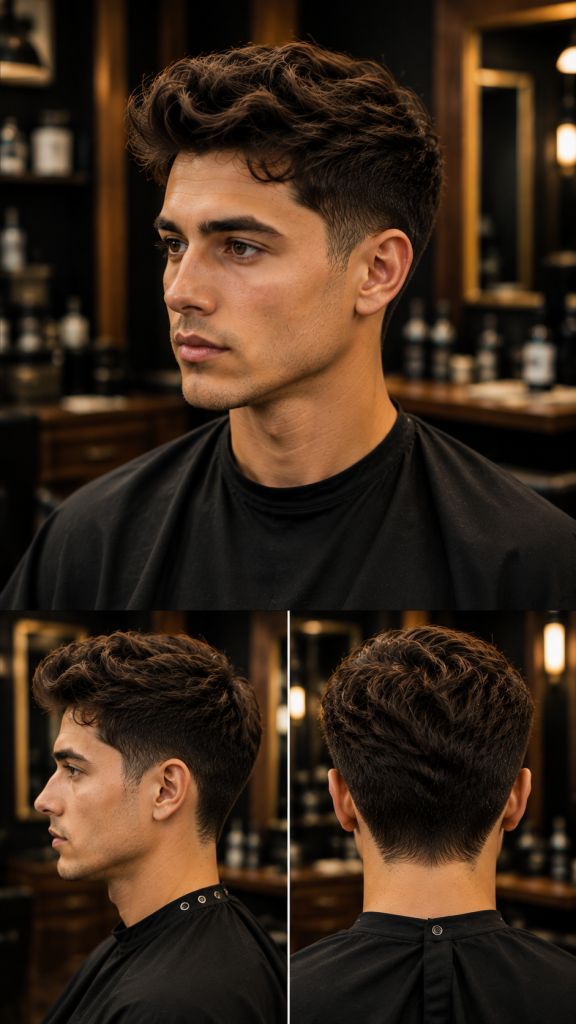
Taper Fade Front View
From the front, a taper fade often looks remarkably natural.
The upper sides remain relatively full, while the temple and sideburn areas become progressively shorter.
This subtle transition cleans the face without completely changing the overall shape of the haircut.
Because the taper occupies less visual space, attention remains primarily on the hairstyle itself.
A side part retains its classic character.
Curls remain full and expressive.
Medium-length textured hair can preserve its relaxed movement.
Even longer hairstyles can benefit from a taper because the edges look intentionally maintained without requiring the rest of the hair to be extremely short.
This flexibility is one of the taper fade’s greatest strengths.
Temple Taper Details
The temple area is especially important from the front.
A carefully blended temple taper creates a smooth transition from the hairline toward the sideburn.
It can be subtle enough that the fade is barely noticeable from a distance while still making the haircut look considerably cleaner.
This is ideal for someone who wants precision without dramatic contrast.
Facial hair can also be integrated into the taper.
When a beard is present, the sideburn transition can gradually connect the haircut with the facial hair, producing a unified appearance rather than an abrupt division.
That small detail can significantly improve the overall finish.
Taper Fade Back View
From behind, the taper fade differs substantially from both low and high fades.
Instead of creating a broad faded section across the entire back, the shortest transition is typically concentrated near the neckline.
Above this area, the hair remains noticeably fuller.
This means the natural shape and density of the back are preserved.
The neckline still looks crisp and intentional, but the haircut does not appear extensively shaved.
For someone comparing Fade and Taper Haircuts Front and Back Views, this is one of the easiest ways to distinguish a taper from a conventional fade.
Look at how much fullness remains through the back.
If the fade is mainly concentrated around the edges while the central back remains relatively full, the haircut is likely closer to a taper.
Natural Neckline Versus Tapered Neckline
A conventional blocked neckline creates a distinct edge where the hair ends.
A tapered neckline behaves differently.
Instead of ending abruptly, the hair gradually becomes shorter toward the neck.
This can create a softer and more natural growing-out process.
As new hair appears, there is less of an obvious boundary between the haircut and the neck.
That is one reason tapered necklines are attractive for people who prefer a low-maintenance appearance.
The haircut may lose its freshly cut sharpness over time, but it often continues to look intentional.
Why the Taper Works with Longer Hair
One major advantage of the taper is that it does not require extremely short sides.
That makes it particularly compatible with medium and longer hairstyles.
Imagine textured medium-length hair with movement through the top and sides. A full fade might remove too much of that shape.
A taper can simply clean the sideburns and neckline while allowing the remaining texture to stay intact.
This makes the haircut ideal for styles where natural volume is important.
Curly and wavy hair can especially benefit because the taper creates structure around the edges without sacrificing the texture that gives the hairstyle its personality.
Who Should Choose a Taper Fade
The taper is a strong option for anyone seeking a haircut that feels clean, modern, and understated.
It is particularly useful for professional settings where an extreme skin fade may feel unnecessarily bold.
At the same time, it is far from old-fashioned.
Combined with modern texture, curls, or carefully styled longer hair, a taper can look exceptionally contemporary.
Its greatest strength is restraint.
Rather than transforming the entire silhouette, it refines what is already there. ✨
Fade and Taper Haircuts Front and Back Views Side by Side
Comparing all three styles from both directions makes their differences much clearer.
From the front, the high fade produces the strongest contrast because the sides become extremely short relatively high on the head. The low fade retains more side volume, while the taper preserves the greatest amount of natural fullness.
From the back, those differences become even more obvious.
The high fade creates the largest short section.
The low fade creates a smaller gradient closer to the neckline.
The taper focuses primarily on cleaning and gradually shortening the edges.
Think of the three styles as a spectrum:
Taper Fade → Low Fade → High Fade
Moving from left to right generally increases the amount of hair removed from the sides and back and increases the visual contrast between the top and lower sections.
That simple framework can make choosing between them considerably easier.
Which Fade Looks Best From the Front
There is no universally best option because the desired effect differs from person to person.
For balance and versatility, the low fade is difficult to beat. It cleans the sides while preserving enough fullness to complement many face shapes and hairstyles.
For maximum visual impact, the high fade wins. Its reduced side volume places immediate emphasis on the top.
For subtle refinement, the taper fade offers the most natural appearance.
The top hairstyle also matters.
Someone wearing a dramatic pompadour may appreciate the contrast of a high fade, while someone with loose waves may prefer a taper that preserves movement around the sides.
Which Fade Looks Best From the Back
The answer depends on what you want the back of the haircut to communicate.
A high fade looks extremely crisp and intentionally sculpted.
A low fade appears balanced and smoothly graduated.
A taper looks natural, full, and understated.
Hair density can also influence the result. Keeping additional weight through the back may help create a fuller appearance, whereas removing more hair can emphasize the shape of the head.
This is why rear-view references are so valuable.
The front alone cannot reveal these differences clearly.
Skin Fade Versus Shadow Fade
Another important decision is how short the lowest section should become.
A skin fade transitions all the way down to bare or nearly bare skin. This produces maximum contrast and an exceptionally clean finish.
A shadow fade leaves a small amount of visible hair at its shortest point.
The result is softer.
Both approaches can be applied at different heights.
For example, you can have a low skin fade or a low shadow fade. Likewise, a high fade can transition to skin or retain some darkness at the base.
The choice influences both appearance and maintenance.
Skin fades tend to look sharper immediately after the haircut, but regrowth becomes visible sooner because the contrast between bare skin and new hair is obvious.
Shadow fades often grow out more subtly.
Choosing a Fade Based on Hair Texture
Hair texture can dramatically alter how a fade appears.
Straight Hair
Straight hair tends to make the structure of the haircut highly visible.
Transitions, weight lines, and differences in length can be easy to see, particularly when the hair is dark and dense.
Low fades work exceptionally well when the goal is to combine a neat gradient with a textured or swept top.
High fades can create a sharper, more graphic result.
Tapers are excellent for maintaining natural flow through medium-length straight hairstyles.
Wavy Hair
Wavy hair offers natural movement that pairs beautifully with all three options.
A low fade can clean the perimeter while preserving substantial wave texture.
A high fade emphasizes the waves by creating stronger contrast underneath them.
A taper allows the waves to remain present throughout more of the sides and back.
The best choice depends largely on how much natural volume you want to preserve.
Curly Hair
Curly hair and fades are an especially effective combination. 🌀
The contrast between tight, clean sides and dimensional curls can create a highly defined silhouette.
A high fade makes curls on top the dominant focal point.
A low fade provides a more gradual transition and retains additional curl around the sides.
A taper is excellent when preserving a fuller curly shape is important.
Because curl patterns vary significantly, the transition should be adapted to the individual rather than copied exactly from another haircut.
Coarse and Thick Hair
Thick hair provides enough density to create exceptionally smooth fade gradients when handled correctly.
A fade can also reduce excessive bulk around the sides.
A high fade removes the most weight, while a low fade controls the lower perimeter without significantly reducing upper-side density.
A taper preserves the most fullness.
For someone with very thick hair who frequently feels that the sides become bulky, a low or high fade may therefore offer practical advantages beyond appearance.
Matching Top Hairstyles With the Top 3 Fades
The fade should not be treated as an isolated element.
Its success depends on how it interacts with the hairstyle above it.
Low Fade Combinations
A low fade pairs beautifully with a textured crop, quiff, side part, curls, slick back, short pompadour, or messy textured top.
Because the fade remains relatively low, these hairstyles maintain enough side weight to feel balanced.
This makes the low fade perhaps the easiest of the three options to experiment with.
High Fade Combinations
High fades are especially effective with hairstyles designed around strong contrast.
Think textured crops, short curls, crew cuts, buzz cuts, spiky texture, pompadours, and structured tops.
The dramatically shortened sides create a clean foundation that makes the top appear more prominent.
Taper Fade Combinations
Tapers work particularly well with hairstyles that benefit from natural fullness.
Side parts, curls, waves, longer textured tops, brushed-back styles, and medium-length cuts can all work beautifully.
The taper keeps the perimeter neat without forcing the entire hairstyle into an aggressively faded shape.
How to Explain the Haircut to Your Barber 💈
Clear communication is more useful than simply knowing the name of a haircut.
Start by identifying the fade height you want.
If choosing a low fade, indicate that you want the transition kept relatively close to the ears and neckline.
For a high fade, explain that you want the shorter section carried substantially higher.
For a taper, clarify that you want to preserve fullness through the sides and back while tapering mainly around the temples and neckline.
Then discuss how short the base should be.
Do you want skin exposure, extremely short stubble, or a darker shadow?
Next, explain the desired top length and styling direction.
Finally, show reference photos whenever possible.
The most useful references include multiple angles.
A clear front photo explains the hairline, top, and temple treatment. A side image reveals the fade height. A back photo communicates the neckline and rear gradient.
Together, these references provide far more information than a haircut name alone.
Maintenance and Growing Out Your Fade
Every fade begins changing as soon as the hair grows.
The question is how noticeable that growth becomes.
High skin fades generally reveal regrowth fastest because a substantial portion of the head begins at an extremely short length.
Low fades can be slightly more forgiving because the transition occupies less area.
Tapers usually provide the softest growing-out process because more hair is preserved from the beginning.
This makes maintenance an important part of choosing a haircut.
Someone who enjoys frequent barber visits may appreciate the crisp precision of a high fade.
Someone who wants a haircut that remains presentable for longer may prefer a taper.
The low fade once again occupies the middle ground, offering substantial cleanliness without necessarily demanding the same level of maintenance as the boldest high fade.
Final Verdict on the Best 3 Fade and Taper Haircuts Front and Back Views
When comparing Fade and Taper Haircuts Front and Back Views, the differences go far beyond where the barber starts using shorter clippers.
Each haircut creates its own silhouette, level of contrast, maintenance routine, and visual personality.
🥇 Best 1 Low Fade is the strongest all-around choice. It offers modern definition without removing excessive volume and works with an enormous range of top hairstyles. From the front, it creates subtle temple definition. From the back, its lower gradient produces a clean but natural transition.
🥈 Best 2 High Fade is the choice for maximum contrast. The front becomes sharper and more vertically focused, while the back reveals a much larger faded area. It is bold, modern, and especially effective when the hairstyle on top deserves to become the main attraction.
🥉 Best 3 Taper Fade provides the most natural and understated result. It cleans the temples, sideburns, and neckline while preserving considerably more fullness through the sides and back. This makes it particularly suitable for classic, professional, curly, wavy, and medium-length hairstyles.
Ultimately, the best choice depends on how much contrast you want.
Choose a taper fade when natural fullness is the priority.
Choose a low fade when you want the most balanced combination of cleanliness and versatility.
Choose a high fade when you want the haircut to look sharp, bold, and immediately noticeable.
Most importantly, never judge a fade only from the front. The back view reveals the height, gradient, neckline, crown connection, and true craftsmanship of the haircut. Looking at Fade and Taper Haircuts Front and Back Views together provides a much more complete picture—and makes it considerably easier to choose a style that looks impressive from every angle.